
Clitoral Vibrators: How to Use One, Vibration vs. Suction & How to Choose
Educational content for adults. It isn’t medical advice. This article links to Vibe Picks, our curated store, which uses affiliate links. See our affiliate disclosure.
A clitoral vibrator is built for the part of the body most closely tied to pleasure for many women. There are two main styles: toys that vibrate, and air-pulse (“suction”) toys that work with changes in air pressure. This guide explains how each works, how to use one, what research can and can’t tell you about the difference, and how to choose without the marketing noise. For the wider picture, including insertable, dual and wand styles, see our complete vibrator guide.
What is a clitoral vibrator?
A clitoral vibrator is a toy designed mainly for external use on the clitoris and the vulva around it, not for insertion. The category covers many shapes: fingertip-sized bullets, lipstick-style vibes, palm-sized “lay-on” toys, wand heads, wearable toys, and the clitoral arm on many rabbit and dual toys.
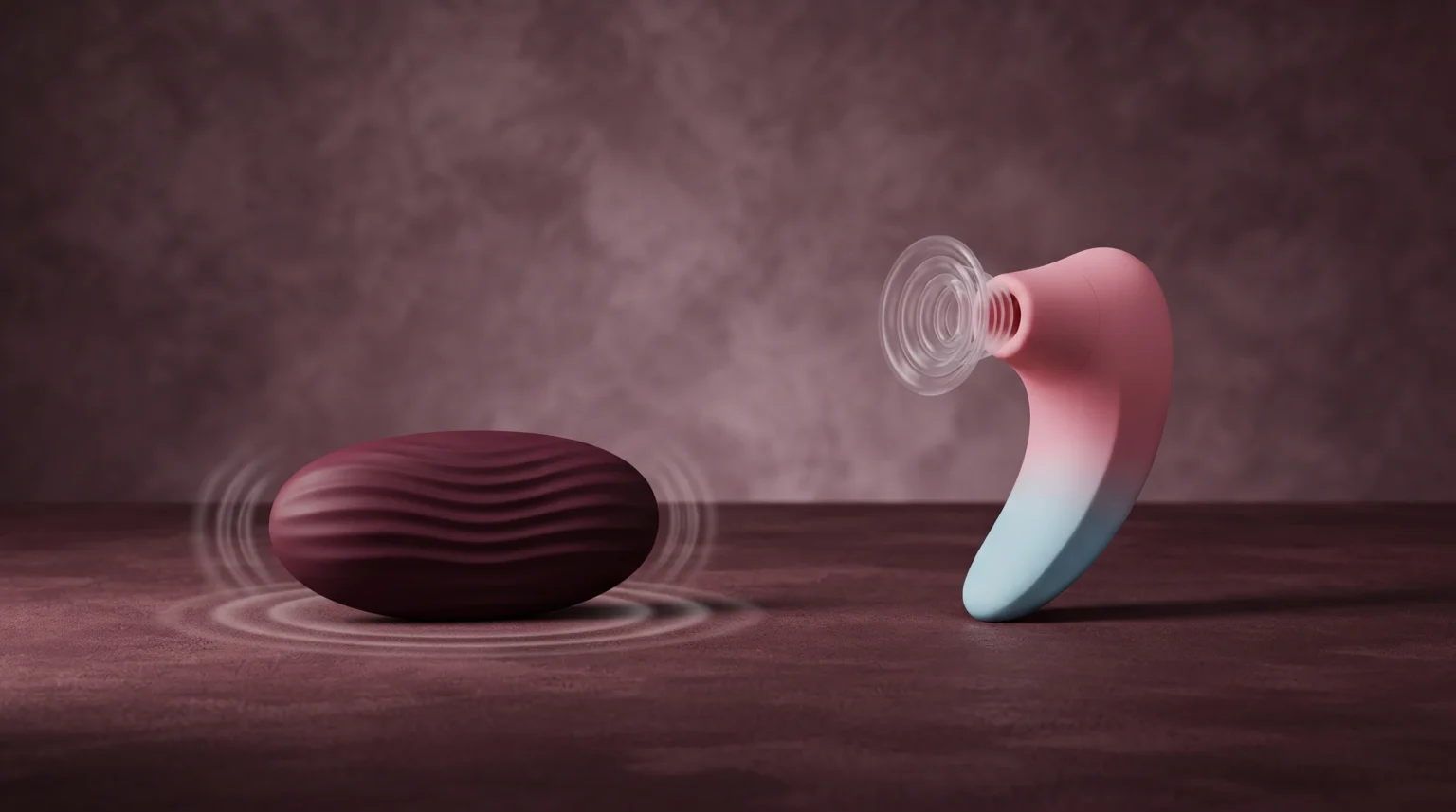
Vibrating toys vs air-pulse (“suction”) toys
- Vibrating toys use a small motor to make the surface of the toy move rapidly. You feel the vibration wherever the toy touches.
- Air-pulse (“suction”) toys have a small, soft opening that sits over the clitoris. Inside, air pressure rises and falls very quickly. Despite the nickname, many consumer devices don’t hold a true vacuum. They alternate between slightly higher and slightly lower pressure (more on that below).
Some toys combine both, with an air-pulse opening on one end and a vibrating tip or panel on the other.
Clitoral anatomy: why the glans is only the tip
Most diagrams show the clitoris as a small nub under a hood. That visible part is real, but it’s a small fraction of the structure. A widely cited anatomical review in the Journal of Urology describes the clitoris as a three-dimensional structure attached to the pubic arch, with parts wrapping around the urethra and vagina (O’Connell et al., 2005).
The glans, body, crura and bulbs
- Glans: the part you can see and touch at the top of the vulva, partly covered by the clitoral hood. The review describes it as densely supplied with nerves and the only external part of the clitoris (O’Connell et al., 2005).
- Body: runs up and back from the glans beneath the skin.
- Crura (legs): two erectile extensions that run along the pubic bone.
- Bulbs: two spongy erectile structures on either side of the vaginal opening. The same review argues they are part of the clitoris, forming a tissue cluster with the urethra and vagina.
This matters for toy use. Because so much of the structure sits beneath the surface, stimulation through the hood, the labia or the skin around the glans can still be felt. That’s why indirect use is an option at all.
What the nerve-count research actually found
One small 2023 study estimated more than 10,000 myelinated nerve fibers across the paired dorsal nerves of the clitoris, although later anatomical work has produced different counts.
- The 2023 study: researchers counted the fibers in nerve samples from people having gender-affirming surgery. Five samples could be analyzed. They counted one side and doubled the number to estimate the total (Uloko et al., 2023).
- The 2024 study: it examined tissue from six body donors and counted roughly 2,900–3,100 nerve fibers per side at the points it sampled. It also estimated that the clitoris is supplied with nerves about six times more densely, per unit of surface area, than the penis (Tunçkol et al., 2024).
Two points are worth keeping straight:
- Nerve fibers are not nerve endings. These studies counted fibers (axons) in the nerve trunks, not the sensory endings in the skin. The 2023 authors noted that the popular “8,000 nerve endings” figure had never actually been measured.
- The exact number isn’t settled. The research agrees that the clitoris is very densely supplied with nerves. It does not agree on one number.
Why clitoral stimulation matters for so many women
A US national probability survey of 1,055 women aged 18 to 94 asked about orgasm during intercourse (Herbenick et al., 2018):
- 18.4% said intercourse alone was enough for orgasm.
- 36.6% said clitoral stimulation was necessary to orgasm during intercourse.
- Another 36% said it wasn’t necessary, but their orgasms felt more pleasurable when the clitoris was also stimulated.
More than seven in ten women in that survey either needed clitoral stimulation during intercourse or said it made orgasm feel better.
A much larger US survey of 52,588 adults found a clear orgasm gap (Frederick et al., 2018):
- 65% of heterosexual women said they usually or always orgasmed during sex, compared with 95% of heterosexual men.
- Women were more likely to orgasm when sex included manual genital stimulation and/or oral sex as well as intercourse.
Vibrators are part of this picture for many people:
- In a nationally representative US study, 52.5% of women had used one (Herbenick et al., 2009).
- Recent users scored higher on most measures of sexual function. That shows an association, not proof that the vibrator caused the difference. The 2009 survey was funded by Church & Dwight, maker of Trojan products, and published in the peer-reviewed Journal of Sexual Medicine.
Vibration vs suction: what’s the difference?
How vibration works
A vibrator’s motor makes the toy oscillate, and that movement passes into the skin it touches. Vibrators differ a lot in how fast they vibrate, how far the surface moves and how forceful the vibration is (Prause et al., 2012). Shoppers often describe the sensation as “buzzy” or “rumbly”, but those labels aren’t standardized between brands.
Basic research also suggests the genitals have sensors suited to vibration. A 2024 study found that sensory structures called Krause corpuscles in the mouse clitoris respond strongly to vibration (Qi et al., 2024). That was mouse research. It doesn’t establish how human genital tissue senses vibration, and it doesn’t tell us which settings suit a human body.
How air-pulse toys work
The original patent behind this style of toy describes the mechanism (US Patent 10,786,422):
- A small chamber has a flexible wall that a motor pushes back and forth.
- This produces alternating positive and negative pressure relative to the surrounding air at the opening.
- With the opening placed over the clitoris, the glans is stimulated by the moving air rather than by a vibrating surface pressing on it. The soft rim rests on the surrounding skin.
That is different from a true vacuum device, which draws and holds suction. Clinical clitoral vacuum devices exist and have been studied separately, for example in a small study that included women with sexual arousal difficulties (Wilson et al., 2001). Brands use their own names for their air-pulse technology, and exact designs vary, so check the product description if the distinction matters to you.
What research can — and cannot — tell us about which feels better
Direct comparative evidence is limited. Here is what exists:
- One randomized trial compared a clinical clitoral vacuum device with vibration (Alexander et al., 2018).
- It enrolled 31 women with multiple sclerosis or spinal cord injury; 23 completed it.
- Both groups improved on orgasm scores, and the vacuum group also improved on several other measures.
- It was a small, specialized group, and it used a true vacuum device, not a consumer air-pulse toy.
- A 2022 ultrasound study compared a wand, an insertable vibrator and an air-pulse device (Murdaugh & Marashi, 2022). It involved one participant, so it can’t be generalized.
- No peer-reviewed trials comparing consumer air-pulse toys with consumer vibrators turned up in our research.
So the honest answer is that neither type has been shown to be more pleasurable, more effective or safer than the other. What you’ll find online is personal experience. Some people describe air-pulse sensation as precise and intense; others find it too much and prefer the broader feel of vibration. Treat those accounts as preferences, not evidence.
Direct vs indirect clitoral stimulation
In the 2018 national survey, women could choose several kinds of genital touch they liked (Herbenick et al., 2018):
- Where: 66.4% liked touch directly on the clitoris, and 52.9% liked touch on the skin around it (beside, above or below). Many chose both.
- How firm: the most common choices were light to medium pressure. Only 10.7% chose firm pressure that pushes deep into the skin.
- What kind of motion: repeated rhythmic motion (84.2%) and motion that circles the clitoris (78.5%) were the most widely liked.
With a toy, direct usually means the tip or air-pulse opening on the glans itself. Indirect means working through the hood, on the labia, just above the glans, through underwear, or at a lower setting.
Neither is the “right” way. They are preferences, and the data suggests plenty of people enjoy both. A practical approach is to start indirect and move closer only if you want more.
How to use a clitoral vibrator
Before you start
- Charge it and read the manual. Check whether the toy is waterproof or only splash-resistant, and how the maker says to clean it.
- Clean it before first use (see Cleaning and hygiene).
- Have lube nearby. In a large randomized daily-diary study, using lube was linked to higher pleasure and satisfaction during solo sex. Among the lubricants studied, the water-based ones were linked to fewer reported genital symptoms than the silicone-based ones (Herbenick et al., 2011).
- Match the lube to the toy. Check the toy manufacturer’s lubricant guidance. If compatibility is unclear, water-based lubricant is the broadly compatible default for silicone toys.
If you’re buying your first toy, our beginner vibrator guide covers the basics.
Using a vibrating toy
- Start on the lowest setting.
- Begin somewhere less sensitive, such as the inner thigh, the mons (the soft area above the vulva) or the outer labia. Then move toward the hood.
- Change position and pressure before you change speed. Moving a few millimetres, or pressing lighter or firmer, often changes the sensation more than another setting does.
- Try holding the toy still and then moving it, including slow circles, which many people enjoy by hand, too.
- If the sensation turns dull or uncomfortable, pause, lower the setting or move to a new spot.
Using an air-pulse toy
- Start on the lowest setting with the toy off your body, so you can feel the pulses on your fingertip first.
- Gently part the labia and place the opening so it surrounds the glans, with the soft rim resting on the skin around it. You don’t need to press hard.
- A little water-based lube on the rim can help it sit comfortably. That tip comes from product guidance, not research.
- If you feel very little, shift the position slightly. Small changes in position can make a big difference with this style.
- If it’s too intense, tilt the toy so the rim seals only partly, move slightly off-centre or use it over the hood.
Intensity: why more isn’t automatically better
- More power isn’t needed just to feel it. In one laboratory study, every common vibrator tested exceeded average genital vibration-detection thresholds (measured in women averaging about 40). That study tested a small set of devices, so it can’t speak for every toy on the market (Prause et al., 2012).
- Some people do want more power. This includes people whose sensation has changed with age or health conditions (Rullo et al., 2018).
- Firm isn’t the common preference. In the 2018 survey only about one in ten women chose firm pressure (Herbenick et al., 2018).
Start low and step up gradually. The top setting is an option, not a target.
How to choose between vibration and suction
Because direct comparative evidence is limited, this is a question of what you enjoy and how you’ll use the toy, not which technology “wins”. These questions help:
- How sensitive is the glans for you? If direct touch often feels like too much, a broad vibrating surface used indirectly is an easy place to start. If you like focused sensation right on the glans, an air-pulse toy or a small, pointed vibrating tip may suit you. Expect to experiment either way.
- Do you want both? Hybrid toys with an air-pulse opening and a vibrating element let you try both sensations with one purchase.
- Where will you use it? If you want it in the bath or shower, look for a clear waterproof rating, not just “splash-proof”.
- How quiet does it need to be? Noise varies a lot between models. Reviews that mention noise levels are useful here.
- What is it made of? Look for non-porous materials such as silicone, hard plastic, glass or stainless steel, and a seller who is clear about materials (Rullo et al., 2018). Our guide to the risks of buying vibrators on Amazon explains how to spot vague or misleading listings.
- Hands-free or partnered use? Small or wearable toys fit between bodies more easily than wands.
- App or remote control? These add features, and they also collect data. Read our guide to app-controlled toys and privacy first.
For six specific options compared by stimulation type, see our best clitoral vibrators. If you’d like to compare options, Vibe Picks has a Clitoral filter that includes both vibrating and air-pulse toys. Vibe Picks uses affiliate links: if you buy through them, VibeSequence may earn a commission at no extra cost to you.
Sensitivity and temporary numbness
Some people notice reduced sensitivity after a long or intense session. In a nationally representative survey of 2,056 women, most had never had any genital symptoms from vibrator use (Herbenick et al., 2009). Reported desensitization has been described as largely mild and temporary. A multidisciplinary expert review considered long-term desensitization from vibrator use unlikely (Rullo et al., 2018).
If it happens, lower the intensity, switch pattern or take a break. Numbness that doesn’t fade is worth a clinician’s attention (see below). For the full evidence, read Can a Vibrator Cause Desensitization or Nerve Damage?
Using a clitoral vibrator with a partner
Using a vibrator with a partner is common:
- Many couples do it. Partnered vibrator use is common (Herbenick et al., 2010).
- A partner’s attitude matters. Their knowledge of, and positivity about, vibrator use is linked to women’s sexual satisfaction (Rullo et al., 2018).
- It fits the wider evidence. Women are more likely to orgasm when partnered sex includes genital stimulation beyond intercourse (Frederick et al., 2018).
A few practical points:
- Talk first, outside the moment. Framing the toy as something you’re adding, rather than a fix for something missing, tends to land well.
- Choose positions that leave the vulva reachable. Side-lying, being on top, or lying back with a pillow under the hips all make room for a toy.
- Small toys are easier. A bullet, a compact air-pulse toy or a wearable fits between bodies. Wands are easier for foreplay or for one partner to use on the other.
- Either of you can hold it. Letting the person receiving the stimulation control the position and intensity is often simplest at first.
- Remote play has privacy trade-offs. If you’re using an app over distance, our app-privacy guide covers what to check.
Cleaning and hygiene
There is no evidence-based cleaning standard for sex toys. Expert guidance is to clean according to the toy’s material. Warm water and mild soap are likely enough for non-porous materials, with extra care around seams and crevices, then air-drying (Rullo et al., 2018).
For clitoral toys specifically:
- Air-pulse toys: the opening and its soft head collect fluid and lube. Many have a removable head; clean it as the maker describes.
- Water resistance: don’t submerge a toy that isn’t rated waterproof.
- Sharing toys: clean between partners, or use a fresh condom over the toy for each person (Rullo et al., 2018). The evidence behind this:
- In a 12-woman study, HPV DNA was still detected on some vibrators after cleaning (Anderson et al., 2014). Detecting DNA doesn’t prove the virus could be passed on.
- Sharing vaginally inserted toys has been linked to bacterial vaginosis in women who have sex with women (Marrazzo et al., 2010).
For more on infections, see Can a Vibrator Cause a UTI, BV or a Yeast Infection?
When to talk to a clinician
- Pain during or after sex or toy use. Pain during sexual activity is worth raising with a health care professional (ACOG).
- Burning, itching, sores, swelling or unusual discharge that doesn’t settle (ACOG).
- Numbness or tingling that persists. This applies especially if it comes with pain, or doesn’t fade after a break. Nerve problems in the pelvis can cause numbness or burning, shooting or tingling pain in the genitals (NHS).
- Difficulty reaching orgasm that bothers you. Anorgasmia (orgasms that are absent, delayed, infrequent or lack intensity despite arousal) has many possible causes, including medications and menopause, and is treatable. Up to 15% of women report never having had an orgasm (Cleveland Clinic). Our guide to why you can’t orgasm with a vibrator covers common reasons and what to try first.
- Any injury from a sexual device.
Myths about clitoral vibrators
“Suction toys are stronger and more effective.” No study has shown that consumer air-pulse toys are more pleasurable, more effective or safer than vibrating ones. Direct comparative evidence is limited (Alexander et al., 2018).
“Suction toys pull the clitoris into a vacuum.” Many consumer air-pulse toys alternate between slightly higher and slightly lower air pressure rather than holding a vacuum (US Patent 10,786,422).
“Clitoral toys cause permanent numbness.” Reported reduced sensitivity has generally been mild and temporary, and experts consider long-term desensitization unlikely (Rullo et al., 2018).
“The clitoris has exactly 8,000 nerve endings.” That figure was never measured. Recent studies estimate nerve fibers, and their counts differ (Uloko et al., 2023; Tunçkol et al., 2024).
“The strongest setting is the most effective.” In one laboratory study, every common vibrator tested exceeded average genital vibration-detection thresholds, and in a national survey firm pressure was a minority preference (Prause et al., 2012; Herbenick et al., 2018).
“Needing a vibrator means something is wrong.” Over half of US women have used one, and most women in a national survey said they needed or enjoyed clitoral stimulation during intercourse (Herbenick et al., 2009; Herbenick et al., 2018).
“Bringing a toy to bed means your partner isn’t enough.” Most people in the US view women’s vibrator use positively (Herbenick et al., 2011), and a partner’s positive attitude is linked to women’s sexual satisfaction (Rullo et al., 2018).
FAQ
How is a female vibrator used?
A clitoral vibrator is generally used externally on the clitoris and surrounding vulvar tissue. Start on a low setting, begin around the area rather than directly on the glans, and adjust position, pressure and speed until it feels good. Lube can make it more comfortable. Insertable and dual styles are covered in our complete vibrator guide.
What is the difference between a vibrator and a suction toy?
A vibrator transmits mechanical vibration through contact with the skin. An air-pulse (“suction”) toy sits over the clitoris and creates rapid changes in air pressure, often alternating rather than holding a vacuum (US Patent 10,786,422). Which one feels good is personal. Direct comparative evidence is limited.
How do clitoral suction toys work?
Inside the toy, a flexible chamber wall moves back and forth. This pushes and pulls air through a small opening placed over the clitoris, so the glans is stimulated by moving air rather than a vibrating surface.
Is it true that suction toys are safer than vibration toys?
There’s no evidence that either type is safer. Direct comparative safety evidence is limited. Survey and expert-review data suggest vibrator-related adverse effects are usually mild and temporary (Herbenick et al., 2009; Rullo et al., 2018). Keep in mind that most consumer air-pulse toys alternate air pressure rather than holding a true vacuum (US Patent 10,786,422); studies of clinical vacuum devices (Alexander et al., 2018) don’t tell us about the safety of consumer air-pulse toys.
Where should a clit sucker be positioned?
Centre the opening over the glans so the soft rim rests on the surrounding skin, without pressing hard. If you feel little, shift slightly; if it’s too intense, tilt it, move off-centre or use it over the hood.
How do you use a clit vibrator during penetration?
Choose a position that leaves the vulva reachable, such as side-lying or being on top, and use a small toy that fits between bodies. Either partner can hold it, but the person receiving stimulation often finds it easiest to control. See Using a clitoral vibrator with a partner.
Why does vibration feel good?
The clitoris is densely supplied with nerves (Tunçkol et al., 2024), which helps explain why it is so sensitive to touch of all kinds, including vibration. You may see headlines about “vibration sensors” in the clitoris. That research was done in mice: it found sensory structures called Krause corpuscles in the mouse clitoris that respond strongly to vibration (Qi et al., 2024). It does not establish how human genital tissue senses vibration, and the exact human sensory mechanism remains unknown.
Sources
- Alexander M, Bashir K, Alexander C, Marson L, Rosen R. Randomized trial of clitoral vacuum suction versus vibratory stimulation in neurogenic female orgasmic dysfunction. Arch Phys Med Rehabil. 2018;99(2):299–305. PubMed
- American College of Obstetricians and Gynecologists. When Sex Is Painful (FAQ). ACOG
- American College of Obstetricians and Gynecologists. Disorders of the Vulva: Common Causes of Vulvar Pain, Burning, and Itching (FAQ). ACOG
- Anderson TA, Schick V, Herbenick D, Dodge B, Fortenberry JD. A study of human papillomavirus on vaginally inserted sex toys, before and after cleaning, among women who have sex with women and men. Sex Transm Infect. 2014;90(7):529–531. PubMed
- Cleveland Clinic. Anorgasmia. Cleveland Clinic
- Frederick DA, St John HK, Garcia JR, Lloyd EA. Differences in orgasm frequency among gay, lesbian, bisexual, and heterosexual men and women in a U.S. national sample. Arch Sex Behav. 2018;47(1):273–288. PubMed
- Herbenick D, Reece M, Sanders S, Dodge B, Ghassemi A, Fortenberry JD. Prevalence and characteristics of vibrator use by women in the United States. J Sex Med. 2009;6(7):1857–1866. PubMed
- Herbenick D, Reece M, Hensel D, Sanders S, Jozkowski K, Fortenberry JD. Association of lubricant use with women’s sexual pleasure, sexual satisfaction, and genital symptoms: a prospective daily diary study. J Sex Med. 2011;8(1):202–212. PubMed
- Herbenick D, Reece M, Sanders SA, Dodge B, Ghassemi A, Fortenberry JD. Women’s vibrator use in sexual partnerships: results from a nationally representative survey in the United States. J Sex Marital Ther. 2010;36(1):49–65. DOI
- Herbenick D, Reece M, Schick V, Jozkowski KN, Middelstadt SE, Sanders SA, Dodge BS, Ghassemi A, Fortenberry JD. Beliefs about women’s vibrator use: results from a nationally representative probability survey in the United States. J Sex Marital Ther. 2011;37(5):329–345. PubMed
- Herbenick D, Fu TJ, Arter J, Sanders SA, Dodge B. Women’s experiences with genital touching, sexual pleasure, and orgasm: results from a U.S. probability sample of women ages 18 to 94. J Sex Marital Ther. 2018;44(2):201–212. PubMed
- Marrazzo JM, Thomas KK, Agnew K, Ringwood K. Prevalence and risks for bacterial vaginosis in women who have sex with women. Sex Transm Dis. 2010;37:335–339. PMC
- Murdaugh KL, Marashi A. Pilot sonographic study of clitoral blood flow and size after use of sexual devices. Sexologies. 2022. ScienceDirect
- NHS. Pudendal neuralgia. NHS
- NOVOLUTO GmbH. Stimulation device. US Patent 10,786,422. Justia Patents
- O’Connell HE, Sanjeevan KV, Hutson JM. Anatomy of the clitoris. J Urol. 2005;174(4 Pt 1):1189–1195. PubMed
- Prause N, Roberts V, Legarretta M, Rigney Cox LM. Clinical and research concerns with vibratory stimulation: a review and pilot study of common stimulation devices. Sex Relation Ther. 2012;27(1):17–34. Taylor & Francis
- Qi L, Iskols M, Greenberg RS, et al. Krause corpuscles are genital vibrotactile sensors for sexual behaviours. Nature. 2024;630:926–934. PubMed
- Rullo JE, Lorenz T, Ziegelmann MJ, Meihofer L, Herbenick D, Faubion SS. Genital vibration for sexual function and enhancement: best practice recommendations for choosing and safely using a vibrator. Sex Relation Ther. 2018;33(3):275–285. PMC
- Tunçkol E, Heim C, Brunk I, Vida I, Brecht M. Innervation pattern and fiber counts of the human dorsal nerve of clitoris. Sci Rep. 2024;14:23060. PubMed
- Uloko M, Isabey EP, Peters BR. How many nerve fibers innervate the human glans clitoris: a histomorphometric evaluation of the dorsal nerve of the clitoris. J Sex Med. 2023;20(3):247–252. PubMed
- Wilson SK, Delk JR, Billups KL. Treating symptoms of female sexual arousal disorder with the Eros-Clitoral Therapy Device. J Gend Specif Med. 2001;4(2):54–58. Johns Hopkins