
Body-Safe Sex Toys: Which Materials to Choose (and Which to Skip)
Educational content for adults. It isn’t medical advice. This article links to Vibe Picks, our curated product recommendations page, and contains two affiliate links. If you buy through them, VibeSequence may earn a commission at no extra cost to you. See our affiliate disclosure.
“Body-safe” is printed on a lot of packaging, but on its own it isn’t a universally recognized certification label. Safety standards and rules do exist, as we explain below. Beyond any label, what tells you how safe a toy is to use is what it’s made of. In practice that means two things: whether the material has a closed, non-porous surface you can clean properly, and whether it’s likely to contain additives you’d rather avoid.
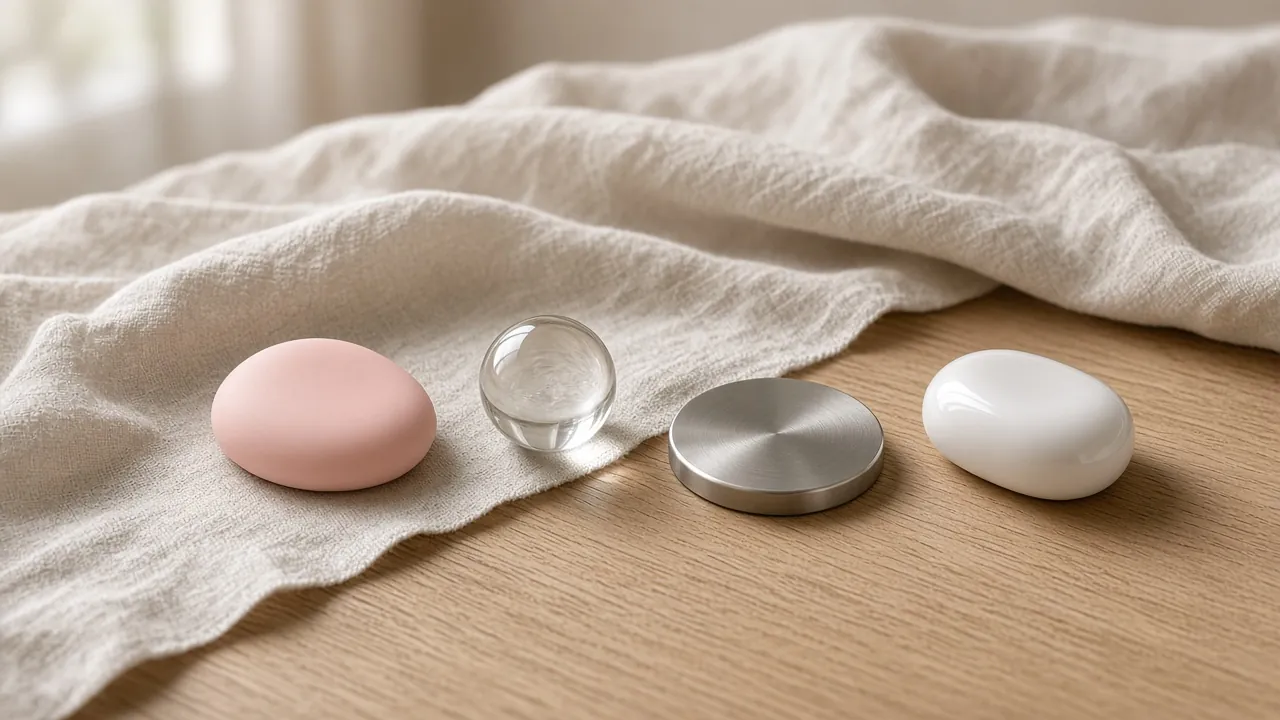
The short version is reassuring. Clinical reviews of sexual devices point to silicone, hard plastic, glass and stainless steel as the sensible choices. This guide explains why, what the chemical studies did and didn’t find, and how to read a product listing so you know what you’re buying. It’s the in-depth companion to the material checklist in our complete vibrator guide.
The short answer
- Usually the best choices: silicone, hard plastic such as ABS, glass and stainless steel. These are non-porous, so they’re easier to clean and disinfect.
- Be more cautious with: soft “jelly”, PVC, TPE/TPR, vague “rubber” and unnamed “realistic-feel” materials. None of these are on clinicians’ list of non-porous materials, and clinical guidance advises avoiding porous materials because they can’t be properly disinfected and can break down over time. These are broad categories, though, and individual products vary.
- Check the listing for named materials. Vague words like “jelly” or “rubber” tell you little. “Body-safe”, “phthalate-free” and “medical grade” are the maker’s own claims unless they’re backed by published specifications, test results or a named standard or certification.
- Regulation is patchy. The EU legally limits four common phthalates in most consumer products, including electrical ones such as vibrators, but makers largely check their own compliance and authorities test samples rather than every product. In the US, most sex toys aren’t covered by specific material rules. An international safety standard for sex toys, ISO 3533:2021, also exists.
- Already own a soft or unlabelled toy? Use a condom over it, keep it to yourself and replace it once it turns sticky, cloudy or cracked.
What “body-safe” actually means
In the sources we reviewed, we didn’t find a single legal or scientific definition of “body-safe”, and the term isn’t by itself a recognized certification. That doesn’t mean no standards apply: an international sex toy safety standard exists, and chemical rules apply in some markets (see below). When clinicians and researchers talk about material safety, they usually mean two separate things.
- Porosity (hygiene). A 2019 clinical reference guide for obstetrician-gynecologists concludes that devices made of non-porous materials are the safest and easiest to clean and disinfect. It says porous materials should be avoided, because they can’t be disinfected and the material can break down (Rubin et al., 2019; clinical review, abstract reviewed).
- Chemistry (what might leach out). Some soft plastics are made flexible with plasticizers, including phthalates. Some phthalates, such as DEHP, are restricted in children’s toys and many other products. The Danish Environmental Protection Agency lists harmful effects on the fetus and on fertility among DEHP’s health effects (see below).
A material can pass one test and fail the other. A phthalate-free soft toy can still be porous. A non-porous toy from an unknown factory can still contain contaminants, as one of the studies below found.
Who regulates sex toy materials?
Less than you might expect, and it depends on where you live.
- United States. The FDA classifies a “genital vibrator for therapeutic use” as a Class II medical device, but only when it’s intended and labelled for treating sexual dysfunction or as an aid to pelvic floor exercises (21 CFR 884.5960). A 2018 review notes that many toys are sold “for novelty use only”, which the authors suggest is a way to avoid FDA regulation (Rullo et al., 2018). A 2023 paper by Duke University researchers adds that the Consumer Product Safety Commission hasn’t applied the kind of material standards it uses for children’s toys to sex toys (Sipe et al., 2023).
- European Union. Since July 2020, EU chemicals law (REACH) has restricted four phthalates (DEHP, DBP, BBP and DIBP) to under 0.1% of the plasticized material in most everyday products, with some exemptions. Electrical equipment is exempt from that rule because it falls under the separate RoHS rules. RoHS limits the same four phthalates to 0.1% in each homogeneous material, and it applies to electrical products such as vibrators. These limits are legal obligations, but compliance is mainly self-assessed: under RoHS the maker checks its own production, keeps technical documentation, signs an EU declaration of conformity and applies the CE mark, with no outside body required to test it. Independent verification, such as third-party lab testing, is optional. Enforcement is by national authorities, which run risk-based checks and lab-test samples where appropriate. So a CE mark doesn’t mean a government has tested that particular toy.
- International standard. ISO 3533:2021, published by the International Organization for Standardization, is an international standard on design and safety requirements for sex toys that come into direct contact with the genitals, the anus or both. We haven’t reviewed the standard itself, so we don’t summarize its requirements. If a maker says a toy meets it, look for the standard named in the product documentation or a test report.
The practical takeaway: a named material, documentation you can check and a reputable seller tell you more than a “body-safe” sticker.
Materials at a glance
| Material | Porous? | What to know |
|---|---|---|
| Silicone | No | The most common soft material in well-made vibrators. It’s easy to wash, but silicone lube may affect it, so check the manual. |
| Hard plastic (ABS) | No | Often used for handles and housings. It’s rigid and easy to wipe clean, but a “hard plastic” label doesn’t guarantee it’s free of contaminants. |
| Glass | No | It has a smooth surface. Check it for chips or cracks before every use. |
| Stainless steel | No | It’s durable and easy to clean. It’s also heavy and feels cool to the touch. |
| TPE / TPR | Not on the clinical non-porous list | Broad families of soft materials, and products vary. Usually cheaper than silicone. Limited evidence suggests they may be harder to clean fully, so a condom and earlier replacement are sensible. |
| Jelly, PVC, vinyl, “rubber” | Not on the clinical non-porous list | These may contain high levels of plasticizers. Clinicians suggest using a condom over them, or avoiding them. |
| Latex | Not on the clinical non-porous list | Some people are allergic to latex. Check the label if that applies to you. |
The “Porous?” column follows the non-porous list in a 2018 clinical review (Rullo et al.). Clinical sources don’t give porosity ratings for individual products.
Silicone: the usual first choice
A 2018 best-practice review on choosing and safely using a vibrator lists silicone among the non-toxic, non-porous materials it’s reasonable to recommend (Rullo et al., 2018; narrative review). That’s a recommendation about the material, not proof that a particular product is made of it.
Two caveats are worth knowing:
- Not every “silicone” toy is pure silicone. Rullo et al. note that some toys described as silicone are probably mixed with other materials. They suggest choosing toys described as “medical grade silicone”, or buying from an established maker that’s open about its materials. On a toy listing, though, “medical grade” is usually the manufacturer’s own description, not independent evidence of safety. It means more when it’s backed by published material specifications, test reports or a named certification you can check.
- Silicone lube and silicone toys don’t always mix. Lovense’s user guides, for example, tell owners to use only water-based lube, warning that silicone or oil-based lube may affect the toy’s silicone casing (manufacturer instruction). Our guide to water-based vs. silicone lube covers this in detail.
Hard plastic (ABS): reliable, with one lesson
Hard plastic, usually ABS, is often the body or handle of a vibrator, sometimes under a silicone coating. Rullo et al. list hard plastic as non-porous, and it’s easy to wipe clean.
The lesson comes from a 2006 Danish Environmental Protection Agency survey, a government chemical survey of 16 products. One stick vibrator made of hard ABS contained cadmium at 200 ppm, well above the 75 ppm limit cited in the report. That’s one product from a small sample, and the survey is now 20 years old. Even so, it shows that a reassuring material name doesn’t make up for an unknown manufacturer.
Glass and stainless steel
Both appear on Rullo et al.’s list of non-porous materials, and both are simple to clean. The main things to watch are physical rather than chemical:
- Glass: check it carefully for chips, cracks or rough edges before each use, and stop using it if you find any.
- Steel: it’s heavy and starts out cool. Some people enjoy that, while others prefer to warm it in their hands first.
TPE, TPR, jelly, PVC and “rubber”: why caution makes sense
Soft, squishy toys are usually cheaper, and some people like how they feel. Here’s what the research says about them.
- Jelly is often PVC. The Danish survey found that the widely used label “jelly” turned out to be plasticized PVC. Plasticizers could make up as much as 70% of the material. Those identified were phthalates, namely DEHP, DNOP and DINP. Most products had no material description at all, and shop staff knew very little about what they were selling (Danish EPA, 2006).
- Clinicians suggest a barrier. Rullo et al. note that some unregulated jelly-rubber vibrators have been found to contain phthalates, and suggest covering jelly toys with a condom.
- TPE and cleaning. In a small 2014 study, 12 women each used two vibrators on separate occasions: a single thermoplastic elastomer (TPE) vibrator and a single silicone one. Each toy was cleaned with a commercial cleaner after use. HPV DNA was still detected on the TPE toy 24 hours later in 2 of the 5 cases that had tested positive right after cleaning. It wasn’t detected on the silicone toy at 24 hours in any case (Anderson et al., 2014; small experimental study, abstract reviewed). Two cautions: finding HPV DNA shows viral genetic material was present, not that infectious virus was there or that infection was passed on. And with a very small sample and one toy per material, the study can’t show that every TPE product behaves the same way.
- Breakdown over time. The 2019 clinical guide gives material breakdown as one of its reasons to avoid porous materials (Rubin et al., 2019).
Not every soft toy is a problem. “TPE” and “TPR” cover many different formulations, so these products don’t all share the same porosity or safety characteristics, and many are sold as phthalate-free. But a listing often doesn’t tell you enough to judge a specific product, and phthalate-free doesn’t mean non-porous. That’s why we still prefer well-documented non-porous materials, especially for shared or internal use.
A note on latex: if you’re allergic to latex, check what a toy is made of. If you put a condom over a toy, choose a latex-free one. The NHS advises against latex condoms if you have a latex allergy, and against using oil-based lubricant with latex condoms (NHS, Condoms).
What the chemical studies found, and what they didn’t
Only a few studies have tested sex toys in a lab, so it’s worth being precise about them.
- Danish EPA (2006), government survey and risk assessment. Researchers screened 16 sex and fetish products for hazardous substances and ran migration tests on 6. For most products, the assessment found no health risk under normal use. It defined normal use of a dildo as 15 minutes once a week, and its worst case as one hour a day. Some products carried minor risks at heavy use, mainly for people who are pregnant or breastfeeding. The report said one product shouldn’t be used by people who are pregnant or breastfeeding, because of a tin compound (trimethyltin chloride) found in it. The type of lube also mattered: DEHP migrated about 100 times less into water-based lube than into oil-based lube.
- Sipe et al. (2023), exploratory lab study. Duke University researchers analyzed four sex toys and found phthalates in all of them, including small amounts of seven phthalates in a silicone-blend external vibrator. When the toys were mechanically abraded, they also shed micro- and nanoplastic particles. The authors found marketing problems too. One toy advertised as “phthalate-free” contained phthalates, and another was labelled both a “novelty” gift and “body safe”. The authors stress that four toys don’t represent the whole market, and that their abrasion test wasn’t designed to mimic real use.
What this means: the evidence doesn’t show that sex toys commonly harm health. Neither study measured health outcomes in people who use toys. It does show that labels can be missing or wrong, that soft plasticized materials are where most of the chemical concerns come from, and that oil-based products can increase how much plasticizer leaches out. These are good reasons to choose a well-documented, non-porous toy, and they’re no reason to panic about one you already own.
How to read a product listing
You can’t test a toy’s chemistry at home, but a careful read of the listing gets you most of the way.
- Find the material line for each part. A clear specification names a material for every part, for example “Silicone, ABS”. SVAKOM’s specifications for its Tulip bullet vibrator (“Silicone, ABS”) and Emma Neo 2 wand (“Silicone, ABS Plastic”) are examples. We’re quoting the maker’s specifications here. We haven’t tested these products or verified their materials independently.
- Treat vague words as a question, not an answer. “Jelly”, “rubber”, “silicone blend”, “realistic feel” or a brand-name “skin” with no polymer named all mean you don’t know what you’re buying.
- Read “body-safe”, “phthalate-free” and “medical grade” as claims. They may well be true, but on their own they’re only as reliable as the company making them. Documentation you can check, like a full material list, lab results or a certification you can look up, is worth more than the label.
- Be wary of “novelty use only”. A toy meant for intimate contact that’s labelled as a novelty is telling you its maker isn’t vouching for that use.
- Check the care instructions before you buy. A clear manual that covers water rating, cleaning and compatible lube is a good sign. A missing manual is a bad one.
- Buy from sellers that state materials and have clear returns. Large marketplaces can mix genuine products with copies. We explain how to spot the warning signs in The Hidden Risks of Amazon Purchases.
We don’t recommend home “burn tests” or similar tricks. They involve an open flame, can damage the toy, and we found no evidence that they reliably identify materials. A strong chemical smell from a new soft toy doesn’t prove anything either, but it’s a fair reason to ask the seller what it’s made of.
If you’d rather start with a shortlist, every product on our curated product recommendations page links to the maker’s own listing, where you can check the material yourself. Not sure what kind of toy suits you? Our short vibe quiz is a gentle place to start.
If you already own a porous or unlabelled toy
You don’t need to throw it away in a panic. These steps keep the risk down:
- Use a fresh condom over it every time. That’s the step clinicians suggest for jelly toys (Rullo et al., 2018). Choose latex-free if you’re allergic.
- Keep it to yourself. Porous toys are the hardest to clean between partners or between body areas.
- Clean it and let it dry fully after every use, following our step-by-step guide to cleaning a vibrator.
- Skip oil-based lubricants and oils with soft plastics. The Danish survey found that oil-based lube greatly increased how much DEHP migrated out of the products tested.
- Replace it once it becomes sticky, cloudy, discoloured, torn or cracked, or if it develops a smell that washing doesn’t remove.
When you replace it, a silicone or hard-plastic toy from a maker that names its materials will be easier to care for.
When to talk to a clinician
If you notice itching, burning, a rash, swelling or unusual discharge after using a toy, stop using it and speak to a doctor, nurse or sexual health clinic, especially if it keeps happening. Mentioning the toy and its material helps them work out whether it’s irritation, an allergy or an infection. Our article on whether a vibrator can cause a UTI, BV or yeast infection looks at the infection question in more depth.
FAQ
Is TPE body-safe?
It depends on the product: TPE and TPR are broad material families, and they aren’t on the list of non-porous materials that clinicians recommend. One very small study of a single TPE and a single silicone vibrator found HPV DNA lingering longer on the TPE toy after cleaning, which shows viral DNA was present, not that infection was passed on. Many TPE products are sold as phthalate-free, and some people use them externally and on their own, with careful cleaning. For toys you share or use internally, a well-documented non-porous material such as silicone is the simpler choice.
Is “medical-grade silicone” a real standard?
On a toy listing it’s usually the manufacturer’s own description, not independent proof of safety. A 2018 clinical review suggests looking for it, or buying from a maker that’s open about its materials, because some “silicone” toys are mixed with other materials. Look for supporting documentation, such as a material data sheet, independent lab results or a certification you can verify.
Does “phthalate-free” mean body-safe?
Not by itself. It addresses one group of chemicals, not porosity, and you’re relying on the maker’s word. In one small lab study, a toy advertised as phthalate-free contained phthalates.
Are cheap toys always unsafe?
No. Price isn’t a material, and some affordable toys are silicone and ABS from makers that publish specifications. A missing material list is a bigger warning sign than a low price.
Related guides
- The Complete Vibrator Guide: Types, How to Choose, Use & Care for One
- How to Clean a Vibrator: Everyday Care, Materials & After an Infection
- Water-Based vs. Silicone Lube: Which Is Best for Your Vibrator (and Your Body)?
- Beginner Vibrator Guide: How to Choose Your First Toy Without Pressure
- The Hidden Risks of Amazon Purchases: Why Beginners Need Reliable Vibrator Reviews
This article is for general education and isn’t a substitute for personal medical advice.
Sources
- Rubin ES, Deshpande NA, Vasquez PJ, Kellogg Spadt S. A clinical reference guide on sexual devices for obstetrician-gynecologists. Obstet Gynecol. 2019;133(6):1259–1268. doi:10.1097/AOG.0000000000003262. PubMed (abstract reviewed)
- Rullo JE, Lorenz T, Ziegelmann MJ, Meihofer L, Herbenick D, Faubion SS. Genital vibration for sexual function and enhancement: best practice recommendations for choosing and safely using a vibrator. Sex Relation Ther. 2018;33(3):275–285. doi:10.1080/14681994.2017.1419558. PMC
- Anderson TA, Schick V, Herbenick D, Dodge B, Fortenberry JD. A study of human papillomavirus on vaginally inserted sex toys, before and after cleaning, among women who have sex with women and men. Sex Transm Infect. 2014;90(7):529–531. doi:10.1136/sextrans-2014-051558. PubMed (abstract reviewed)
- Sipe JM, Amos JD, Swarthout RF, Turner A, Wiesner MR, Hendren CO. Bringing sex toys out of the dark: exploring unmitigated risks. Microplast Nanoplast. 2023;3(1):6. doi:10.1186/s43591-023-00054-6. PMC
- Danish Environmental Protection Agency. Survey and health assessment of chemical substances in sex toys. Survey of Chemical Substances in Consumer Products No. 77; 2006. Summary
- U.S. Code of Federal Regulations. 21 CFR 884.5960, Genital vibrator for therapeutic use. eCFR
- European Union. Commission Regulation (EU) 2018/2005 amending Annex XVII to Regulation (EC) No 1907/2006 (REACH) as regards DEHP, DBP, BBP and DIBP. EUR-Lex
- Directive 2011/65/EU (RoHS), Articles 4, 7 and 16, and Annex II as amended by Commission Delegated Directive (EU) 2015/863. Consolidated text. EUR-Lex
- Regulation (EU) 2019/1020 on market surveillance and compliance of products, Article 11 and Annex I. EUR-Lex
- International Organization for Standardization. ISO 3533:2021, Sex toys — Design and safety requirements for products in direct contact with genitalia, the anus, or both. Geneva: ISO; 2021. ISO (bibliographic reference only; the standard’s content was not reviewed)
- NHS. Condoms.
- Lovense. Ferri user guide (lubricant instructions; manufacturer information).
- SVAKOM. Tulip and Emma Neo 2 product specifications (manufacturer information).